
Beneath the World, a Sea is a science-fiction psychological thriller written by Chris Beckett and first published in 2019.
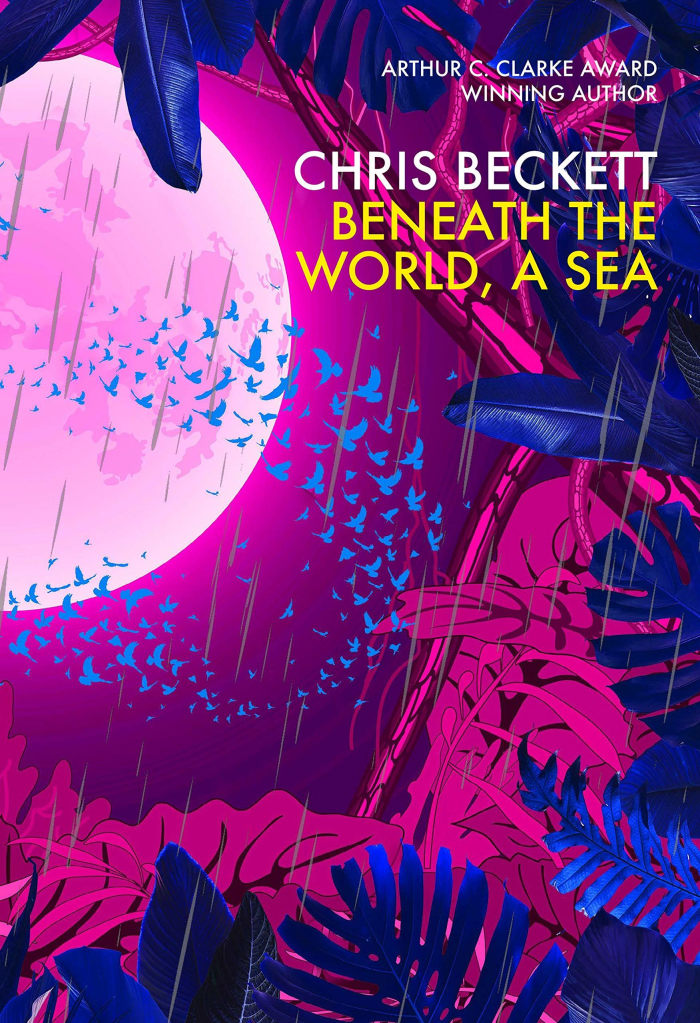
The following paragraph (in italics) contains extracts from the Goodreads introduction –
… a British police officer, arrives in a mysterious forest to investigate a spate of killings of a local species called the Duendes. They are silent, vaguely humanoid creatures … that have a strange psychic effect on people, exposing them to their suppressed thoughts and fears … He becomes fascinated by the Duendes, but the closer he gets, the more he begins to unravel …
Here is the link to my Goodreads review from a reader’s perspective – https://www.goodreads.com/review/show/5822457419
In this post, I focus on my takeaways from a writer’s perspective –
The strongest pillar of this book for me was its world-building. The story is set in the deep forests of South America where an entirely new type of life and ecosystem has been discovered. There are leaves of “plants” that are purple, there are “butterfly-like creatures”, and of course, the Duendes – who are vaguely humanoid creatures such that physical proximity to them can trigger extreme anxiety and psychological breakdown in human beings. This leads to the local tribal community – the Mundinos – to hunt them, and our protagonist is sent to investigate (and stop) these killings.
Now, as a writer, world-building can be a challenge. Where to draw the line between not enough world-building versus too much? How can we avoid not having a compelling world, while also not excessively drowning the reader in so many details that they get bored? This book walks the line extremely well.
The author gives an overall background of the world – that it is a whole ecosystem which is a result of different building blocks of life. But at the same time, the author doesn’t bother to explain most things, and instead focuses on the one plot-relevant species in this ecosystem – the Duendes – alone. Also, a clever way to avoid being “too science-y” is to simply say – even the scientists are baffled. They know as much as you or me. While they are researching with great effort, their understanding is still in its infancy. Another option is go the route of Annihilation – where the scientists’ research is top-secret and even our POV characters have no access to them. Using either option, we can avoid having to give our readers elaborate scientific explanations and leave things unexplained.
Also, rather than keeping things to physical descriptions, there is also commentary on how it affects the POV character. This not only makes the writing richer, but also is a way to do simultaneous worldbuilding and character development – aka, hitting two Duendes with one stone. (I apologize, Duendes are actually cute, and no violence is intended against them).
Now, comes the negative, or what we, as writers can learn to avoid from this book.
While the characters and how they are psychologically affected by the setting is brilliant, there is a significant difference between what is promised in the beginning and what we get in the end.
Towards the end of the book, the story changes from being a slow-burn mystery about Duende-killings to psychological horror where the characters begin to unravel into insanity. While this is brilliantly done, there lies a problem – the story in the end – becomes about the characters, especially the main character, and the bigger questions are not answered.
But at the beginning of the book, we are told about how the scientists are trying to unravel the mystery of what Duendes are and geopolitical agencies are trying to figure out a peaceful solution between Duendes and the local human tribes – the Mundinos. The end doesn’t give a closure on either front, and this is where it annoyed me as a reader.
Fantasy author and podcaster Brandon Sanderson says that the structure of a plot should be based on 3 Ps –
- Promise
- Progress
- Payoffs
You make a promise at the beginning of the book, you show progress towards this promise, and at the end, there is a payoff linked to that promise. In case of this book, one might argue that the real story is about the characters’ psychology, not the Duendos or the larger Delta ecosystem. However, if that is the case, then that needs to be communicated at the beginning of the story. As a writer, we should not promise one thing in the beginning of the story (“Scientists are figuring out what Duendes are”) and then end it with an unrelated conclusion (“This is what our protagonists’ psychology is.”). The end should answer the questions the beginning is answering. And if the question is not to be answered, then don’t ask the question – do NOT make the promise.
What do you think? Do you enjoy books that start as one thing and become a different thing by the end? Does that add to the thrill, or does it end up being unsatisfying? And where do you draw the line between worldbuilding too much and too little?

 Abhirup Dutta Author Website